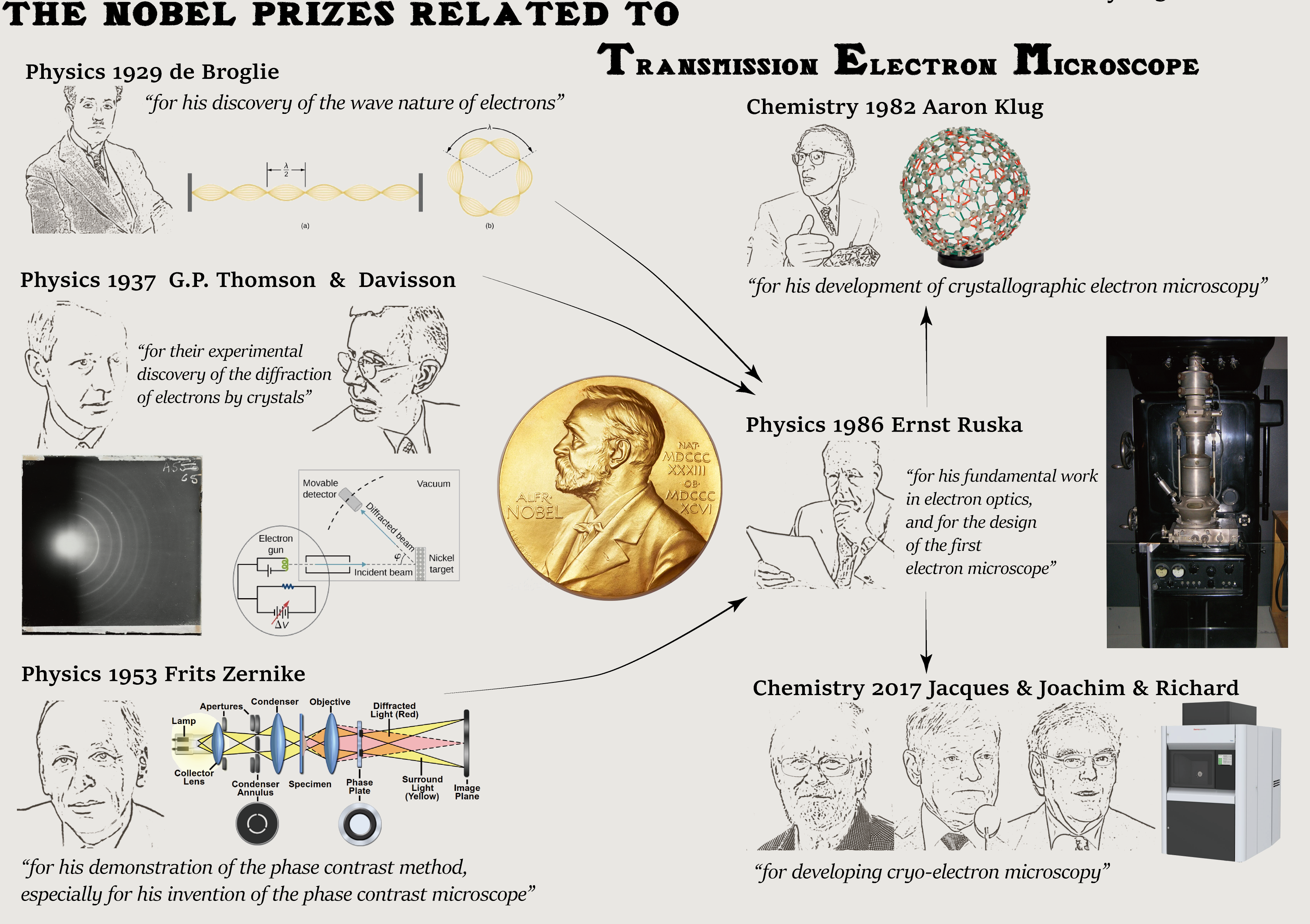
FIB-TEM海报所用的素材收集。
和TEM有关的诺贝尔奖
首先确认所有和TEM有关的Nobel Price:
| 年份 | 奖项 | 获奖者 | 与 TEM 的关系 |
|---|---|---|---|
| 1929 | 物理学 | de Broglie | 电子波动性(原理基础) |
| 1937 | 物理学 | Davisson, G.P. Thomson | 电子衍射(原理基础) |
| 1953 | 物理学 | Zernike | 相衬法(原理基础) |
| 1982 | 化学 | Aaron Klug | 晶体学电子显微术 |
| 1986 | 物理学 | Ernst Ruska | 第一台电子显微镜 |
| 2017 | 化学 | Dubochet, Frank, Henderson | 冷冻电镜(cryo-EM) |
De Broglie & Matter Wave
Nobel Prize in Physics 1929
Name: Prince Louis-Victor Pierre Raymond de Broglie
Prize motivation: “for his discovery of the wave nature of electrons”
Work: introduced idea that particles, such as electrons, could be described not only as particles but also as waves.
De Broglie hypothesis:
Nobel Lecture: broglie-lecture.pdf [1]
Davisson, G.P. Thomson & Electron Diffraction
Nobel Prize in Physics 1937
Name: Clinton Joseph Davisson & George Paget Thomson
Prize motivation: “for their experimental discovery of the diffraction of electrons by crystals”
Work: electrons could be described as waves, when an electron beam passed through a nickel crystal, diffraction patterns appeared.
Zernike & Phase Contrast
Nobel Prize in Physics 1953
Prize motivation: Frits Zernike
Prize motivation: “for his demonstration of the phase contrast method, especially for his invention of the phase contrast microscope”
Work: When light passes through a transparent object, there is a change in the phase of the light waves, the position of the wave crests’ in relation to one another. Our eye does not perceive this, but in the beginning of the 1930s, Frits Zernike developed a way to make it visible. A light beam is passed through an object while a reference beam goes by it. When the beams are brought together, they are strengthened or canceled out because of phase displacement, and the object is outlined more clearly in contrast to its surroundings.
Introduction to Phase Contrast Microscopy | Nikon… [2]
Klug & Crystallographic Electron Microscopy
Nobel Prize in Chemistry 1982
Name: Aaron Klug
Prize motivation: “for his development of crystallographic electron microscopy and his structural elucidation of biologically important nucleic acid-protein complexes”
Work: combined methods from x-ray crystallography with electron microscopy in order to study complex structures of DNA and proteins in organisms such as various viruses and in chromatin, which forms the chromosomes inside cell nuclei.
TEM, STEM
The Nobel Prize in Physics 1986 was divided, one half awarded to Ernst Ruska “for his fundamental work in electron optics, and for the design of the first electron microscope”, the other half jointly to Gerd Binnig and Heinrich Rohrer “for their design of the scanning tunneling microscope”.
Cyro-EM
The Nobel Prize in Chemistry 2017 was awarded jointly to Jacques Dubochet, Joachim Frank and Richard Henderson “for developing cryo-electron microscopy for the high-resolution structure determination of biomolecules in solution”.
Summary
De Broglie for Matter Wave; Davisson, G.P. Thomson for Electron Diffraction; Zernike for Phase Contrast; Klug for Crystallographic Electron Microscopy; Ernst Ruska for TEM; Gerd Binnig and Heinrich Rohrer for STM; Jacques Dubochet, Joachim Frank and Richard Henderson for Cyro-EM.
海报设计
诺贝尔奖自己的海报很有特色,网上也有AI生成器:Generate Noble Prize Style Images with Flux1 AI [3]
本来想给的提示词是“A NOBEL2 portrait illustration of people mention below gold and black pen sketch on textured paper. The title says “THE NOBEL PRIZE related to TEM”. A red burgundy footer overlay at the bottom has the text “De Broglie for Matter Wave; Davisson, G.P. Thomson for Electron Diffraction; Zernike for Phase Contrast; Klug for Crystallographic Electron Microscopy; Ernst Ruska for TEM; Gerd Binnig and Heinrich Rohrer for STM; Jacques Dubochet, Joachim Frank and Richard Henderson for Cyro-EM””,然耳网站需要登录,遂放弃。
成图